
Appsbd

Repeat Customers

After a Big WooCommerce Campaign: 7 Ways to Turn One-Time Buyers into Repeat Customers
A successful WooCommerce campaign can produce a large number of orders in a short period. But turning those buyers into repeat customers can be a difficult follow-up challenge. Many campaign buyers purchase because of a deadline, discount, seasonal need, or social promotion. Once the campaign ends, they may have no clear reason to return or become repeat customers.

The campaign is not finished when the payment is processed. The period after the first order determines whether a shopper remains a one-time buyer or becomes one of your repeat customers. This period includes order communication, product education, support, feedback collection, personalized recommendations, and carefully timed incentives.

This article explains seven practical ways to turn one-time buyers into repeat customers without relying on permanent discounts. The methods apply to most WooCommerce stores, although the best combination depends on your product type, purchase cycle, margins, and customer expectations.

The central idea is simple: give customers a good reason to come back, then make their next purchase easy and relevant. A points program can help increase repeat customers, but it cannot compensate for late delivery, a confusing product, poor support, or an unsuitable offer.

Why campaign buyers do not automatically become repeat customers

A campaign usually optimizes for an immediate action: click, sign-up, or purchase. Customer retention requires a different set of decisions. You must understand what happens after the first order and remove the reasons a customer might not return.

The most common causes are practical rather than mysterious:

  • The buyer has not received enough information to use the product successfully.
  • The product is consumable or replaceable, but the store does not remind the customer when a new purchase may be needed.
  • The first-order discount attracts customers who are only interested in the lowest price.
  • The shopper has a poor delivery, returns, or support experience.
  • Follow-up messages are generic, too frequent, or unrelated to the original purchase.
  • A second order requires too much searching, account setup, or checkout effort.
  • The customer does not understand the benefits of returning.

A campaign can therefore increase the number of first orders while leaving the repeat customer rate unchanged. That is not necessarily a campaign failure. It may mean the acquisition and retention stages were planned separately.

Customer retention is the practice of encouraging existing customers to buy again and continue their relationship with a business. Useful measurements include repeat customer rate, purchase frequency, average order value, customer lifetime value, and churn. Shopify explains these measures and provides formulas for them in its customer retention guide.

For a WooCommerce store, begin with a baseline before changing your follow-up process. Record the number of unique customers from the campaign, the number who make another purchase within a defined period, the time between orders, and the average value of those orders. Then compare the results with earlier campaigns or a similar non-campaign cohort.

What to do immediately after the campaign

Do not send every campaign buyer the same offer immediately after purchase. First, separate the customer journey into stages.

Stage one is order confidence. Send an accurate confirmation, delivery update, and clear support instructions. Customers need to know what they bought, what happens next, and where to ask for help.

Stage two is product success. Provide instructions, setup advice, care guidance, or a short explanation of the next useful step. If the customer uses the product successfully, a future purchase becomes more likely.

Stage three is relationship building. Ask for feedback, explain relevant benefits, and invite the customer to stay connected. This is where a loyalty program, referral offer, or product recommendation may be useful.

Stage four is the next purchase. When the timing and product are appropriate, offer a clear route to a relevant second order. The message should be based on what the customer bought rather than on the fact that the customer exists in your database.

Important: A customer retention message should be useful even if the customer does not purchase immediately. A sequence that exists only to deliver discounts can train customers to wait for another promotion.

Seven ways to turn one-time buyers into repeat customers

  1. Build a useful post-purchase onboarding sequence

The first post-purchase message should reduce uncertainty. Thank the buyer, confirm the order, and explain the next step. Transactional messages should remain accurate and should not be overloaded with unrelated promotional content.

After the order is delivered, send an onboarding message that helps the customer get value from the product. The content depends on what you sell:

  • A clothing store can provide sizing, care, styling, or fitting guidance.
  • A beauty store can explain product order, usage frequency, and compatibility.
  • A food or beverage store can provide preparation suggestions and storage advice.
  • A software store can explain installation, account access, and the first task to complete.
  • A home goods store can provide setup, maintenance, safety, or room-specific ideas.

The message should connect directly to the item purchased. “Here is how to use your product” is more useful than “Here are our latest deals.” Customers who obtain value from the first order have a stronger reason to consider a second order.

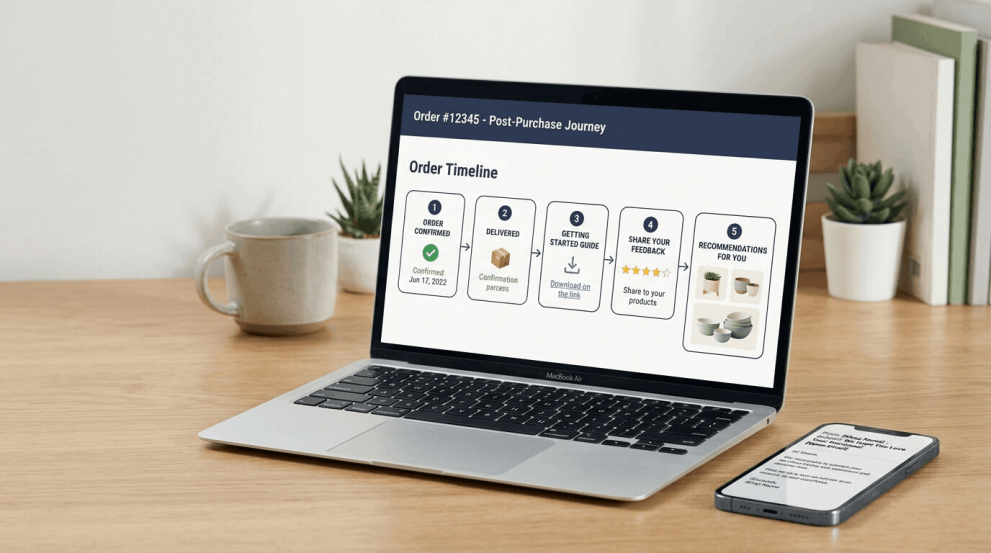
A simple sequence might look like this:

  • Order confirmation:confirm the products, delivery details, support route, and expected timing.
  • Delivery message:explain where to find instructions and what to do if there is a problem.
  • Usage message:provide one or two practical tips that help the customer succeed.
  • Feedback request:ask a focused question after the customer has had enough time to evaluate the product.
  • Relevant next-step message:recommend a refill, accessory, complementary item, or service only when it fits the original purchase.

The timing should reflect the product. A customer buying a consumable may need a replenishment reminder in a few weeks. A customer buying durable furniture may need care advice rather than a near-term purchase request.

This is one of the most reliable ways to retain WooCommerce customers after a sale because it improves the experience before asking for another transaction. It also creates a natural place to learn whether the first order met expectations.

Repeat Customers

2. Segment campaign buyers by product, behavior, and intent

Campaign buyers are not one audience. Some may have bought a low-priced trial item. Others may have purchased a high-value product. Some clicked several product pages before ordering, while others responded to a single limited-time offer. Treating these groups identically makes your follow-up less relevant.

At minimum, create segments using the following information:

  • Product or category purchased.
  • First-order value and margin.
  • New customer versus existing customer.
  • Purchase source or campaign.
  • Delivery or support status.
  • Engagement with email or site content.
  • Whether the product is consumable, seasonal, durable, or complementary to another product.

The goal is not to collect every possible data point. The goal is to make better decisions about what each customer should receive next.

For example, a customer who bought a coffee machine may receive brewing instructions, compatible supplies, and a replenishment reminder. A customer who bought a winter coat may receive care guidance and related accessories, but not a message suggesting another coat the next day. A customer who contacted support about a delayed order should receive a service resolution before a cross-sell offer.

Use behavioral signals carefully. Opening an email does not prove purchase intent. Adding a product to a cart does not guarantee interest in every item in the same category. Give customers a way to update preferences and avoid inferring sensitive characteristics that are not necessary for the shopping experience.

Segmentation is a core part of a repeat purchase strategy because relevance often matters more than message volume. A smaller, well-matched offer can perform better than a store-wide coupon that reduces margin for customers who would have bought anyway.

3. Make the second purchase easier than the first

The first order requires discovery, evaluation, trust, and checkout. The second order should remove much of that work. Make it easy for customers to find the product they already bought, a suitable refill, or the next logical item so they have a clear path to becoming repeat customers.

Useful improvements include:

  • Add a “buy again” route in the customer account area where possible.
  • Link directly to the relevant product or category from the post-purchase email.
  • Keep product names, images, and options consistent across messages and landing pages.
  • Show compatible accessories instead of a long list of unrelated products.
  • Save preferences only with clear consent and provide an easy way to change them.
  • Reduce unnecessary checkout steps for returning customers.
  • Explain shipping, returns, and stock availability before the customer reaches payment.

A second purchase should not depend on the buyer remembering the exact product name from a campaign email sent weeks earlier. Clear links and recognizable product information reduce friction.

Consider whether your store needs customer accounts. Accounts can support order history, reordering, saved details, and returns. However, forcing account creation too early can create friction. A better approach for many stores is to allow a smooth first purchase and then explain the practical benefits of an account after the order.

The same principle applies to coupons. If the customer needs to copy a code, find an item that qualifies, meet an unclear minimum, and resolve a conflict with another promotion, the incentive may not feel valuable. State the offer, eligibility, expiry, and redemption steps in plain language.

4. Use a customer loyalty program with controlled rewards

A customer loyalty program can give first-time buyers a reason to return and become repeat customers, but it should be designed around profitable behavior rather than indiscriminate discounting. Customers should understand how points are earned, what they are worth, and how they can be used.

For a WooCommerce store, possible reward actions include:

  • Completing an account registration.
  • Making a purchase.
  • Purchasing selected products or reaching an order-value range.
  • Referring a new customer.
  • Returning to the store for an approved engagement action.
  • Reaching a clearly explained milestone or badge level.

The reward should match your margin and purchase cycle. If a product is rarely purchased, points that expire before the next likely purchase may frustrate customers. If a product has a high return rate, award or confirm points only according to a policy that accounts for refunds and cancellations.

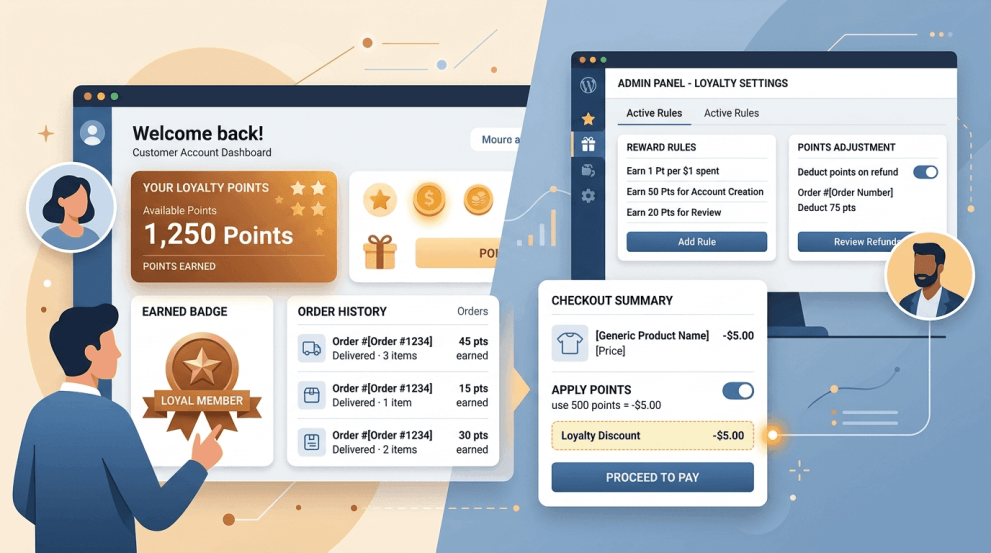
Appsbd’s Vite Rewards is a verified Appsbd option for WooCommerce and Vitepos. Its official product information lists signup points, daily login rules, referral points, per-order rewards, order-amount ranges, product-based rewards, badges, email templates, shortcodes, a user points log, redemption limits, and refund-point management. It also lists WooCommerce and Vitepos integration.

That feature set can support several parts of a retention program. For example, a store could award a modest number of points for the first order, provide additional points for a later order within a reasonable category, and set a maximum number of points that can be redeemed on one order. The store could also use badges to make progress visible without turning every message into a discount.

Before installing or configuring a loyalty plugin, define the program rules in a spreadsheet or written policy. Decide:

  • Which actions earn points.
  • When points become available.
  • What happens after cancellation, refund, or chargeback.
  • How many points can be used in one order.
  • Whether points apply to sale items, shipping, taxes, or selected categories.
  • Whether points expire and how customers are informed.
  • How the store will monitor liability and abuse.

Do not describe points as cash unless the legal and financial treatment supports that wording. “Points toward a discount” is often clearer, but the exact terms should match your store policy and local requirements.

Vite Rewards may be relevant when a store wants a points-based system inside its WooCommerce workflow. It is not a substitute for a product-quality review, a returns process, or useful customer communication. Test the configuration with a staging or test order before promoting it widely.

This is a practical answer to the question, “What is the best loyalty program for WooCommerce repeat purchases?” There is no universal best program. The suitable choice is the one whose earning rules, redemption controls, refund behavior, customer-facing display, and reporting match the store’s economics and technical setup.

After a Big WooCommerce Campaign: 7 Ways to Turn One-Time Buyers into Repeat Customers - img 02
5. Send lifecycle emails instead of repeated campaign blasts

A campaign email is tied to a promotion. A lifecycle email is tied to a customer event or stage. After a large WooCommerce campaign, lifecycle messages help you continue the relationship without repeating the same urgency.

A useful lifecycle program may include these messages:

Welcome and confirmation. Explain the order and the support route. Do not make the customer search for basic information.

Product education. Provide instructions, use cases, or care advice that relate to the purchase.

Feedback request. Ask for a review or a short response after the product has been used. Make the question specific and explain how the feedback will be handled.

Replenishment reminder. Send it based on an estimated usage period, not an arbitrary schedule. Let customers adjust the timing.

Complementary recommendation. Recommend a product that solves a clear next problem. Avoid suggesting a product merely because it shares a category.

Loyalty update. If customers have points or a badge, show what they earned and the next action available. Do not hide redemption conditions in a long paragraph.

Win-back message. If the expected repurchase window has passed, acknowledge the gap and offer a useful route back. An offer may be appropriate, but it should not be the only option.

The subject line and content should identify why the recipient is seeing the message. “Your refill options for the item you purchased” is more informative than “You will not believe this deal.” Keep frequency limits in place so customers do not receive a product email, loyalty email, campaign email, and abandoned-cart email on the same day.

Measure more than open rates. Track clicks to relevant products, repeat purchases, unsubscribe rates, complaint rates, revenue after discounts, and the time from the first order to the second. A message that receives many clicks but produces low-margin orders or high unsubscribes may need revision.

The best post-purchase email is not necessarily the most promotional one. It is the message that arrives when the customer has a real question or a realistic next need, helping create repeat customers without unnecessary pressure.

6. Turn support and returns into a reason to trust the store

Retention is affected by what happens when something goes wrong. A customer who receives a fast, clear resolution may continue buying. A customer who must repeat the same issue across several channels may leave even if the original product was acceptable.

Set clear expectations for delivery, returns, exchanges, refunds, warranty coverage, and support response times. These policies should be visible before purchase and easy to find after purchase. Avoid making a customer contact support simply to learn where a return should be sent.

When a problem occurs, use a structured process:

  • Confirm that the store has received the issue.
  • State the next action and the expected time.
  • Ask only for information that is necessary to resolve the case.
  • Keep the customer updated if the timeline changes.
  • Confirm the resolution and explain any follow-up requirement.
  • Record the cause so the store can reduce repeated problems.

Do not send an upsell message while an unresolved complaint is open. A discount does not replace an explanation, refund, replacement, or correction. If the customer has had a poor experience, a sincere resolution may be more valuable than an incentive.

Returns also affect loyalty points and customer records. If your store uses a rewards system, establish how points are adjusted after a refund. Appsbd’s Vite Rewards page specifically lists refund-point management and a user points log as features. Confirm that the configured behavior matches your store’s policy and test partial refunds, canceled orders, and returned items.

A good service experience can increase the chance that a first-time buyer becomes one of your repeat customers because it reduces the perceived risk of placing another order. The store does not need to pretend that problems never occur. It needs to handle them consistently.

7. Ask for feedback, then use it to improve the next offer

A review request is useful, but feedback should also help the store make better retention decisions. Ask customers what they found useful, confusing, missing, or difficult. Keep the survey short and avoid requiring positive wording.

Useful questions include:

  • Which product did you buy?
  • What were you trying to accomplish?
  • Was the product easy to use?
  • Was any information missing before or after purchase?
  • What would you consider buying next?
  • What nearly stopped you from ordering again?

The answers can reveal different problems. If customers like the product but cannot find compatible accessories, improve cross-linking. If customers are unsure when to reorder, improve lifecycle timing. If customers are disappointed by delivery, review logistics before increasing ad spend. If the first-order discount attracted buyers who do not need the product again, adjust campaign targeting rather than forcing a loyalty offer.

Use feedback in aggregate and protect individual privacy. Do not turn a single comment into a universal conclusion. Compare feedback with purchase behavior, returns, support tickets, and product margins.

A repeat purchase strategy should change as the store learns. The store may discover that an educational message performs better than a discount for one category, while a replenishment reminder works better for another. Use controlled tests where possible. Change one major variable at a time, define the measurement period, and compare similar customer groups.

After a Big WooCommerce Campaign: 7 Ways to Turn One-Time Buyers into Repeat Customers - img 03
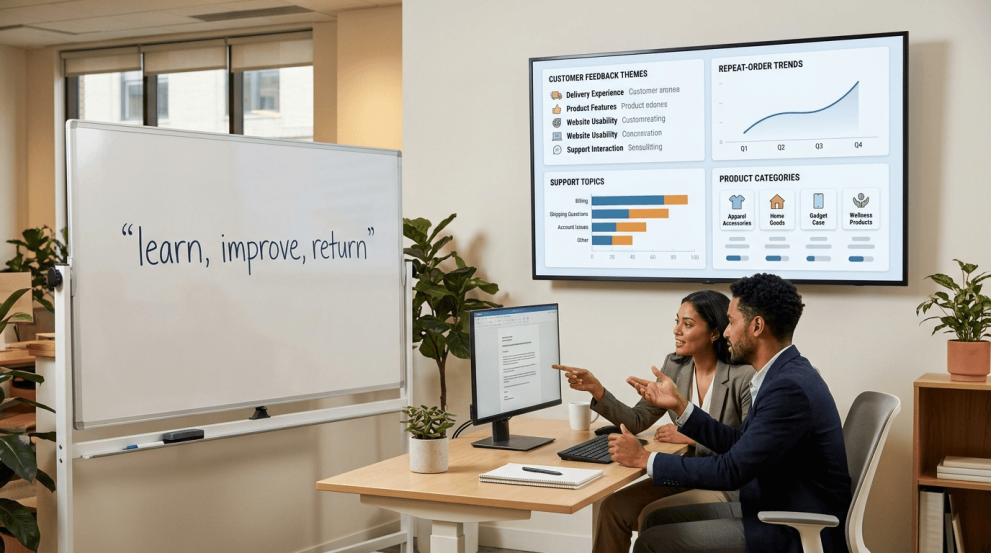
A step-by-step 30-day retention plan

The following plan is a starting framework. Adjust the schedule for your product’s normal repurchase interval.

Days 0–3: confirm and reassure

Send accurate order and delivery communications. Make support, returns, and product instructions easy to access. Do not ask for a review before the customer has had a reasonable opportunity to receive or use the product.

Days 4–10: help the customer succeed

Send a concise onboarding message. Link to the most relevant guide, setup page, care instructions, or usage advice. If customers commonly make a mistake, address it directly.

Days 7–14: invite feedback

Ask one or two useful questions. Provide a straightforward review path, but do not make a positive review a condition of receiving support or a benefit.

Days 14–21: introduce the next relevant action

Based on the product and behavior segment, recommend a refill, accessory, related category, or loyalty action. If using points, explain the earning and redemption rules clearly.

Days 21–30: test a measured return incentive

Only after the customer has received useful follow-up should you consider a return incentive. It may be free shipping, points, a product bundle, a small credit, or a targeted coupon. Compare its incremental effect with a non-discount reminder.

If the product normally lasts 90 days, do not treat day 30 as a missed repurchase. Use a longer timeline and continue providing relevant education. The objective is not to force an order before the customer needs one.

How to measure whether the plan works

A retention program needs a defined cohort and time window. For example, compare customers who made their first purchase during the campaign with customers from an earlier campaign who bought a similar product category.

Track these measures:

Metric

What it tells you

Basic calculation

Repeat customer rate

How many unique customers bought more than once

Repeat-purchase customers ÷ unique customers × 100

Purchase frequency

How often customers ordered during a period

Total orders ÷ unique customers

Time to second order

How long it takes to reach a repeat purchase

Date of second order − date of first order

Average order value

The average amount per order

Revenue ÷ number of orders

Discount-adjusted contribution

Whether the repeat order is economically useful

Revenue minus product, fulfillment, payment, and incentive costs

Unsubscribe or complaint rate

Whether follow-up is creating fatigue or distrust

Unsubscribes or complaints ÷ delivered messages

Use a consistent definition of “repeat customer.” A customer who placed two orders in the same day may be different from a customer who returned after 60 days. Report both the number of repeat customers and the timing of the second order.

A high repeat customer rate is not automatically good if repeat orders are heavily discounted, unprofitable, or associated with increased support costs. Conversely, a modest rate may be reasonable for durable products with long replacement cycles. Compare results with your own historical performance and product economics rather than using an arbitrary benchmark for repeat customers.

For stores using WooCommerce, ensure that guest orders, account orders, refunds, and merged customer records are handled consistently. If the same person can appear under several email addresses, the repeat customer rate may be understated. If family members share an account, it may be overstated from an individual-customer perspective.

Common mistakes to avoid

Sending a discount before delivering value

A coupon does not solve uncertainty about delivery, setup, fit, or quality. Resolve the first-order experience first.

Rewarding every action without a clear purpose

Too many points can make a program difficult to understand and costly to manage. Reward behaviors that support a realistic customer relationship.

Treating all products as replenishable

A durable item may need education, service, or accessories rather than a frequent purchase reminder. Match the timing to actual product use.

Ignoring refunds and cancellations

If points remain after a refunded order, the reward liability and customer experience may become inconsistent. Document and test the adjustment process.

Measuring only campaign revenue

Campaign revenue describes acquisition performance. It does not show whether buyers returned, how profitable the second order was, or whether the experience created long-term value.

Over-communicating

Multiple automated messages can feel like pressure. Set frequency limits, prioritize important service messages, and give customers control over marketing preferences.

Using vague recommendations

“Customers also bought” is less useful than a recommendation tied to the original purchase. Explain why the suggested item may be relevant.

When technical help may be needed

A small store can begin with a basic post-purchase sequence, clear policies, and manual customer segments. Technical assistance may be useful when the store needs complex integrations, reliable event tracking, multiple storefronts, POS synchronization, custom reward logic, or detailed customer data controls.

Ask for help before launch if points are not appearing correctly, refunds are not adjusting balances, emails are firing at the wrong stage, customer records are duplicated, or checkout rules conflict with other discounts. Test changes in a staging environment and keep a record of the original configuration.

For a store that uses both online and in-person sales, Appsbd’s official site identifies Vite Rewards as compatible with WooCommerce and Vitepos.Confirm the current integration behavior, version compatibility, and support process before depending on the connection for a major campaign.

FAQ

Start with a reliable post-purchase experience. Confirm the order, help the customer use the product, send relevant lifecycle emails, make reordering easy, and offer a loyalty or return incentive only when it fits the product and margin. Measure the second-order rate by customer cohort.

Send order and delivery information first. After delivery, send product instructions or care advice. Then ask for focused feedback and, at an appropriate time, recommend a relevant refill, accessory, or next product. This answers the question of what to send customers after their first purchase without treating every customer as ready for another sale.

No. A loyalty program can give customers a reason to return, but it cannot replace product quality, accurate fulfillment, fair returns, or useful support. Points work best when the earning rules and redemption process are easy to understand and financially sustainable.

There is no universal best option. Choose a system that supports the reward actions your store needs, explains balances clearly, handles refunds correctly, limits redemptions where appropriate, and fits your WooCommerce setup. Vite Rewards is one Appsbd option with the verified features described above, including order rules, badges, points logs, redemption limits, and refund-point management.

Vite Rewards

Choose a fixed period, count the customers who made more than one purchase, and divide that number by the total number of unique customers in the same period. Multiply by 100 to express the result as a percentage. Keep guest orders, refunds, and customer identity rules consistent so the comparison is meaningful.

Not necessarily. A universal discount may reduce margin and train customers to wait for promotions. Test alternatives such as free shipping, points, useful education, a product bundle, or a targeted offer. Give the incentive a clear purpose and measure its incremental effect.

Use the product’s normal usage and replacement cycle. A consumable may justify a replenishment message after several weeks, while a durable product may need months of education or an accessory recommendation. The right timing is based on customer need, not a fixed campaign calendar.

Conclusion

A large WooCommerce campaign creates an opportunity, not a guarantee, of long-term customer value. The work of creating repeat customers begins after the first order. Customers need confidence that the store will fulfill its promise, practical help using what they bought, relevant communication, and a simple reason to return.

The seven actions are connected. Build a useful onboarding sequence. Segment campaign buyers. Make the second purchase easier. Use a controlled customer loyalty program. Send lifecycle emails. Treat support and returns as part of retention. Then use feedback to improve the next offer.

For stores that want a points-based system, Vite Rewards is a relevant Appsbd product to evaluate for WooCommerce and Vitepos. Its listed features can support order rewards, signup and referral rules, badges, points logs, redemption limits, and refund adjustments. Configure those features around a clear customer experience and sustainable economics rather than adding rewards without a plan.

The most durable repeat purchase strategy is not the one with the largest discount. It is the one that gives customers a credible, timely, and convenient reason to choose the store again and become repeat customers.

Subscribe

To get news about new releases, Updates, Blog Post, Deals and Discounts

Like this content? Want to share it with others

Appsbd's Other Apps

Vitepos

Vitepos

We've built a fast and easy-to-use Point of Sale system for WooCommerce. It lets you manage your local and online stores in one app, saving you time and money while ensuring a seamless experience for your customers.
Vite Rewards

Vite Rewards

Vite Rewards is a comprehensive loyalty points plugin designed to incentivize customer engagement and boost sales on your WooCommerce store. With a wide range of features, ViteRewards allows you to reward customers for various actions and interactions, creating a more engaging shopping experience.
Elite Licenser

Elite Licenser

Elite Licenser is a top WordPress license manager plugin that controls software, plugin, theme, and app activations. Its premium feature protects against unauthorized usage.
Mini Cart Drawer

Mini Cart Drawer

This plugin adds a customizable mini cart to your WooCommerce site, with an easy control panel and WP Customizer support. It also includes a sale booster that offers dynamic discounts like "Spend $20 more for a $2 discount," encouraging customers to buy more.
Vite Coupon

Vite Coupon

Vite Coupon is a comprehensive coupon management system designed to simplify the creation, distribution, and tracking of discount coupons for online businesses. This plugin integrates seamlessly with various e-commerce platforms, offering a user-friendly interface and robust features to enhance promotional strategies.
User & Kiosk App

User & Kiosk App

Vitepos User App is an addon that lets customers place orders directly, making shopping and dining faster and more convenient. Guests can scan a table QR code to view menus and order without waiting for staff. Orders are instantly processed by the Vitepos Core App, ensuring smooth workflow. The app also supports kiosk devices for efficient self‑service stations.
Member Area
Member Area

Members Area is a private section for registered users to manage licenses and view details. It also supports coupon management on platforms like AppSumo and PitchGround, with tools to create, import, export, and generate unique codes easily.
Support System

Support System

Best Support System, Best by name, Best by nature, Best by feature, it is a self-hosted customer support desk software. It handles support tickets, manages email tickets, collects any payment by PayPal.


Subscribe
Notify of
guest
0 Comments
Oldest
Newest Most Voted
Inline Feedbacks
View all comments

0
Would love your thoughts, please comment.x
()
x