


Referral Programs vs Loyalty Points: Which Works Better?
Written by Md Ferdous Hassan Alin. Posted in Rewards Plugin, WooCommerce, WordPress No Comments
Most online stores reach a point where growth slows down. New visitors cost money to attract, and many first-time buyers never come back. Two reward systems usually come up at this stage: a referral program and a loyalty points program. Both give customers something in return for an action, but they work on different parts of the customer journey.
This guide compares referral programs vs loyalty points in plain terms. It explains what each one does, which problem it addresses, what published research says about referred customers, and how to choose for a WooCommerce store. It also covers how to start a referral program in WooCommerce, how to reward repeat customers in WooCommerce, and where a loyalty points plugin for WooCommerce stores such as Vite Rewards fits.
The short answer is that neither option wins in every case. The better choice depends on whether your main problem is finding new buyers or keeping the ones you already have.
What Are Referral Programs and Loyalty Points?
Before comparing the two, it helps to define each one clearly.
What a referral program is
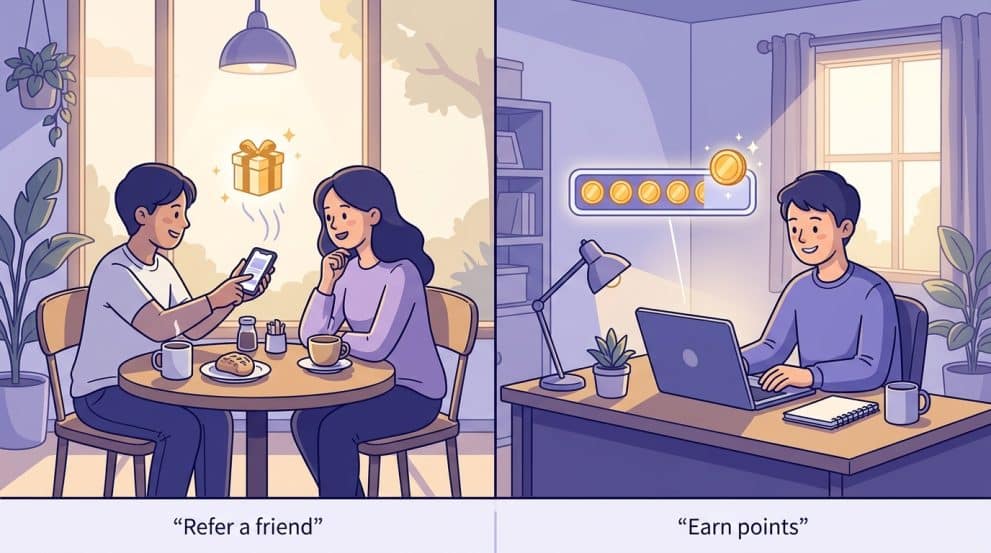
A referral program rewards an existing customer when they bring in a new one. The reward can be points, a discount, store credit, or a gift. It is paid when the new customer completes a defined action, usually a first purchase. The main purpose of a referral program is customer acquisition.
What a loyalty points program is
A loyalty points program gives customers points for actions such as buying, signing up, or logging in. Customers later redeem those points for a discount on a future order. A loyalty points program is built for customer retention. It gives people a reason to return to your store instead of buying from another one.
The two are not the same thing, and one does not replace the other. A referral program changes who arrives at your store. A loyalty points program changes what happens after they arrive.
Referral Programs vs Loyalty Points: Key Differences
The table below summarises the main differences. It describes how these programs usually work, not a fixed rule for every store.
Factor | Referral program | Loyalty points program |
|---|---|---|
Main goal | Customer acquisition | Customer retention |
Who is rewarded | The customer who refers, and often the new customer | The customer who buys or takes a defined action |
What triggers the reward | A new customer completes a first order | A purchase, sign-up, login, or other set action |
Where the cost comes from | Rewards paid per new customer | Discounts given when points are redeemed |
Main risk | Self-referrals and fake accounts | Reduced margin if points are too generous |
Works best when | You have satisfied customers willing to recommend you | Products are bought more than once |
Read side by side, referral programs vs loyalty points is less a contest than a question of fit. A store that sells items people buy once a year has little use for a points balance. A store that sells everyday items can get more from points than from asking customers to recruit friends.
The Problem Both Programs Try to Solve
The choice between referral programs vs loyalty points starts with the problem you want to fix. Both programs target the same broad issue from different angles.
What the problem is
Stores pay to attract buyers through ads, search, email, and social media. If a buyer purchases once and never returns, the store has to pay again to replace that revenue. Growth then depends on a constant supply of new visitors.
Why it happens
A shopper has little reason to prefer one store over another unless something makes the choice easy. Price comparison is simple online, and a one-time buyer has no relationship with the brand. Without a reason to return, many people do not.
Common causes
- The product is bought rarely, so there is no natural reason to return.
- The store sends no follow-up after delivery.
- Customers do not know what the store offers beyond their first purchase.
- There is no reward or incentive tied to repeat behaviour.
- Satisfied customers have no easy way to recommend the store.
- Shipping, returns, or product quality leave buyers disappointed.
The last cause matters because no reward system can fix a poor experience. A referral program depends on customers being happy enough to recommend you. A loyalty points program depends on customers having a reason to buy again.
How to diagnose it
You can find out which problem is larger with a few numbers from your WooCommerce reports and analytics:
- Repeat purchase rate. Divide customers with two or more orders by total customers. A low figure points to a retention problem.
- Time between first and second order. A long gap suggests customers forget about you or have no reason to return.
- Source of new customers. Check how many come from paid ads and how many come from direct visits or recommendations. A heavy reliance on paid traffic suggests acquisition costs are the pressure point.
- Cost per new customer. If this is rising while repeat orders stay flat, both problems may exist.
A practical reading: if repeat purchase rate is low, start with a loyalty points program. If repeat purchases are reasonable but new customers are expensive to find, a referral program is the better first step. If both are weak, begin with retention, because a referral program works better when the customers you already have are satisfied and active.
What the Research Says About Referred Customers
Part of the interest in referral programs comes from academic research. A 2011 study in the Journal of Marketing by Schmitt, Skiera and Van den Bulte tracked about 10,000 customers of a German bank for almost three years. The authors found that referred customers had a higher contribution margin, higher retention, and at least 16% higher value than non-referred customers with similar demographics. The margin difference shrank over time, while the retention difference persisted.
There are limits to how far this result carries. The data came from a bank, not an online store, so the same size of effect cannot be assumed for WooCommerce shops. The authors also found that the value gap varied between customer segments and advised a selective approach to referral programs. Treat the study as a reason to test a referral program, not as proof of a specific outcome for your store.
Strengths and Limits of a Loyalty Points Program
Strengths
- It supports repeat purchases by giving customers a reason to return.
- It works with a small customer base, because it does not depend on customers recruiting others.
- You control the rules: what earns points, how much they are worth, and when they can be used.
- A points log shows what customers did and when, which helps you understand buying behaviour.
- Points can reward actions other than purchases, such as creating an account or logging in.
Limits
- Redeemed points are a discount, so generous rules reduce margin.
- Customers who buy rarely will not earn enough points to care.
- If the value of points is unclear, customers ignore them.
- It does little for customer acquisition on its own, since only people who already know your store can earn points.
Strengths and Limits of a Referral Program
Strengths
- It brings in new customers through a recommendation from someone they know.
- You can structure rewards so they are paid only after a new customer buys.
- It can lower the amount you spend on paid advertising for each new customer, if the rewards cost less than the ads they replace.
Limits
- It needs a base of satisfied customers. A small or unhappy base produces few referrals.
- It can attract abuse, such as people referring themselves with extra accounts.
- Rewards that are too small are ignored, and rewards that are too large can cost more than they return.
- Rules on incentivised recommendations and disclosure vary by country. Check the advertising and consumer rules that apply in your market.
Loyalty Points vs Referral Rewards for Small Stores
Small stores often cannot run everything at once, so the question of loyalty points vs referral rewards for small stores is mostly about where to start. These practical recommendations are not fixed rules, and your own data should have the final say.
- Few customers so far: Start with a loyalty points program. A referral program needs a group of happy customers to draw from, and points help build that group.
- Products people reorder (food, beauty, supplies, consumables): Favour points. The reward matches the buying pattern.
- Products people buy once or twice (furniture, equipment, large gifts): Favour a referral program, since repeat purchases are rare.
- High advertising costs per new customer: Test a referral program to see whether recommendations are cheaper than ads.
- A physical shop alongside the online store: Choose a points system that works in both places so one balance follows the customer.
- Low profit margins: Keep either reward small and cap how many points a customer can redeem per order.
When choosing between referral programs vs loyalty points for a small store, the safest starting point is usually points. They are simpler to run, easier to control, and still useful if you add referrals later.
How to Start a Referral Program in WooCommerce
If you are asking how to start a referral program in WooCommerce, the steps below apply whichever tool you use.
- Set a clear goal. For example, bring in new customers at a lower cost than your current ad spend.
- Decide who gets rewarded. You can reward only the referrer, or both the referrer and the new customer.
- Choose the reward. Points, a coupon, or store credit all work. Pick something that fits your margin.
- Set the trigger. Pay the reward after the new customer’s order is completed, not when they only sign up. Consider waiting until the return period ends.
- Write anti-abuse rules. Allow one reward per new customer, block self-referrals, and set a minimum order value.
- Make sharing easy. Customers should find their referral details in their account area or in an email, without extra steps.
- Tell customers about it. Mention it in order confirmation emails and on the account page.
- Review results monthly. Check how many referred customers placed orders and what the rewards cost.
For step 3, Vite Rewards lists a Referral Reward rule as a Pro feature in its changelog (added in version 2.0.0, dated July 30, 2026). If you plan around it, confirm what your plan includes before you build the campaign.
How to Reward Repeat Customers in WooCommerce
How to reward repeat customers in WooCommerce depends on which behaviour you want to encourage. A points system gives you several options:
- Points per order. A fixed number of points for every completed order encourages frequent buying, regardless of order size.
- Points by order amount. Points scale with the order total, which encourages larger baskets.
- Points by amount range. Different spending bands earn different point values, such as more points above a set order total.
- Points for signing up. A starting balance gives new account holders a first reason to come back.
- Points for daily logins. This rewards frequent visits, though it suits stores with a regular browsing habit more than occasional ones.
- Badges or tiers. Visible status levels give customers a goal to work toward.
- Email reminders. A short message about a points balance can prompt a return visit.
As an illustration only, a store might give one point for every unit of currency spent and let 100 points reduce an order by a fixed amount. The numbers should come from your own margins. Work out what a redeemed point costs you before you publish the rules.
Loyalty Points Plugin for WooCommerce Stores: Where Vite Rewards Fits
If you decide on points, a loyalty points plugin for WooCommerce stores saves you from building the logic yourself. Vite Rewards is a loyalty points plugin for WooCommerce and Vitepos. This section lists what the product page and changelog describe, so you can compare it with your needs.
Earning rules
The product page lists these ways for customers to earn points:
- Sign-up points for new registrations
- Daily login points
- Points per order (a fixed number per order)
- Points based on order amount
- Points based on order amount range
- Global assigned product points, which award points for products bought in the store
- Referral points (listed in the changelog as a Pro rule)
Redemption and control settings
- A maximum number of reward points that can be redeemed in one order
- Point values set per currency
- Refund handling, so points are adjusted when an order is cancelled or refunded
- Redemption forms that can appear on the cart and checkout pages, including Gutenberg cart and checkout
- Reward point notifications on the online cart page
Customer-facing and admin tools
- Badges that mark customer milestones
- Email templates for sign-ups, order completion, point redemption, and badge updates
- Shortcodes that display dynamic content such as a point redemption form
- A user points log that records when points were earned, redeemed, or adjusted
- A reward point table and a customer reward panel
- Points Expiry, listed in the changelog as a Pro feature
Working with a physical store
Vite Rewards integrates with Vitepos, the same company’s point of sale system for WooCommerce. For a store that sells online and in person, this means reward points can be managed in both places. The changelog also notes that you can restrict users from using rewards in Vitepos.
If you also run discount campaigns, the same company offers Vite Coupon, described as a tool for coupons, gift vouchers, and discount codes. It is a separate product, and you should only add it if you need it.
What to check before you buy
- The product page includes a free Lite version, plus yearly and lifetime paid plans. The feature lists on the pricing section look similar across plans, but the changelog marks Referral Reward and Points Expiry as Pro. Confirm which plan includes what you need.
- One store owner quoted on the product page reports a 30% increase in repeat orders after installing the plugin. This is a single self-reported account, not a benchmark, and your results will depend on your products, rules, and customers.
- Test the plugin on a staging site first, including a refund, so you can see how points behave.
Step-by-Step: Set Up a Points Program
These steps describe a general setup, using the features listed above. Menu names can differ by plugin version.
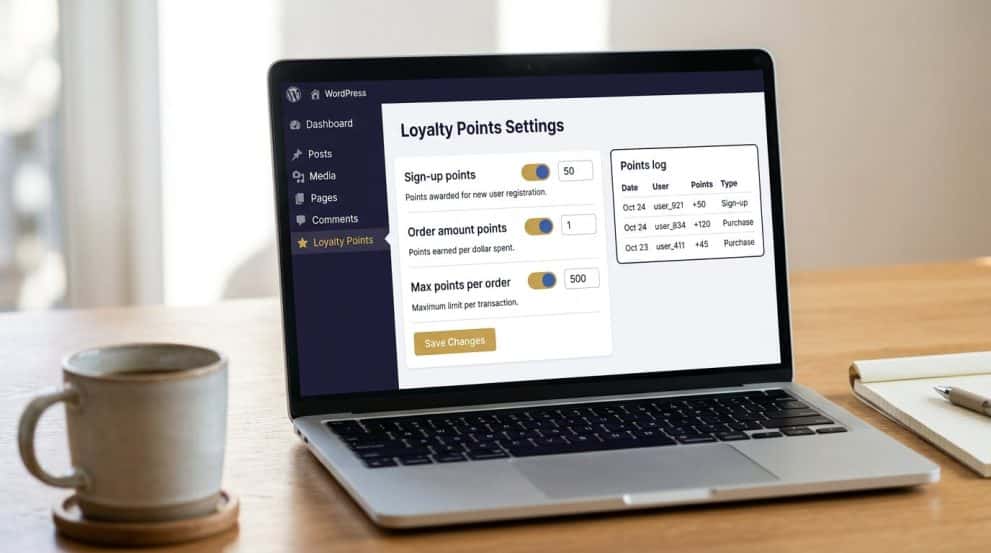
- Install and activate the plugin from the WordPress plugin screen, then open its control panel in the WordPress admin area.
- Set the value of a point. Decide how many points equal a fixed discount and check that the discount fits your margin.
- Add earning rules. Start with sign-up points and points per order or per order amount. Add more rules later.
- Cap redemption. Set the maximum points a customer can use in a single order.
- Set refund behaviour. Make sure points are returned or adjusted when an order is cancelled or refunded.
- Set point values per currency if you sell in more than one currency.
- Edit the email templates so customers receive clear messages about points earned and redeemed.
- Place the redemption form on the cart or checkout page, using the page settings or a shortcode.
- Run a test order, then a test refund, and check the points log.
- Announce the program on your account page and in order emails.
How to Combine Referral and Loyalty Programs
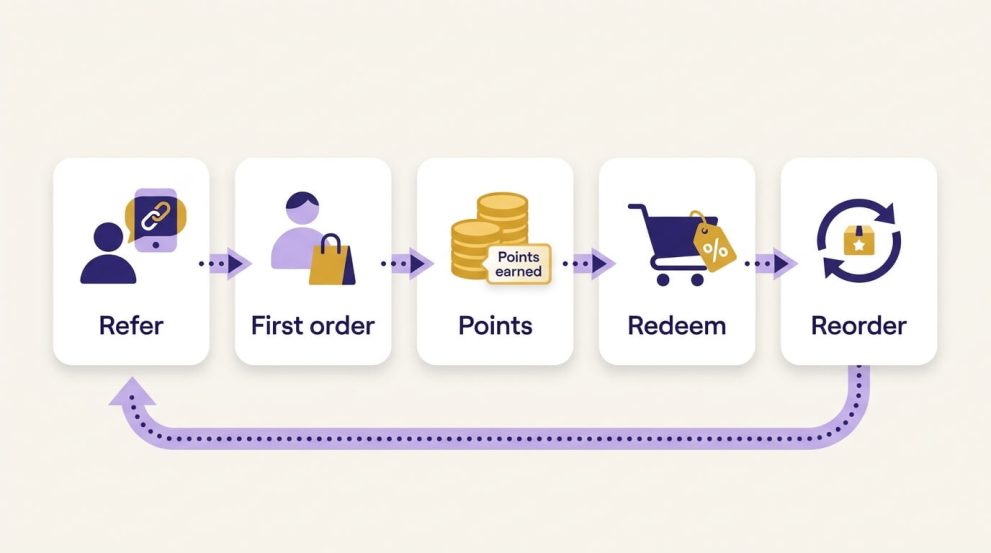
Stores that want both outcomes often ask how to combine referral and loyalty programs without doubling costs. The simplest approach is to pay referral rewards in points.
- A customer refers a friend.
- The friend completes a first order.
- The referrer receives points, and the friend may receive a welcome balance.
- Both can redeem points on later orders.
This links customer acquisition to customer retention. The referrer has a reason to keep shopping, and the new customer starts with a balance that encourages a second order. When you work out how to combine referral and loyalty programs, set one cap on total discounts per order so the two rewards cannot stack past what your margin can handle.
With Vite Rewards, this setup depends on the Pro Referral Reward rule. If you use the free version, you can still run the points side and add referrals when your plan allows it.
Common Mistakes to Avoid
- Treating referral programs vs loyalty points as an either-or choice. Many stores benefit from running them in sequence: points first, referrals later.
- Setting rewards before checking margins. Calculate what each redeemed point or referral reward costs.
- No cap on redemption. Unlimited use of points on one order can wipe out the profit on it.
- Rewarding sign-ups instead of purchases in a referral program. This invites fake accounts.
- Complicated rules. If a customer cannot explain the program in one sentence, they will not use it.
- Ignoring refunds. Points earned on an order that is later refunded should be reversed.
- Never testing. Run test orders, including returns, before launch.
- Not measuring. Without a baseline, you cannot tell whether the program helped.
How to Measure Results
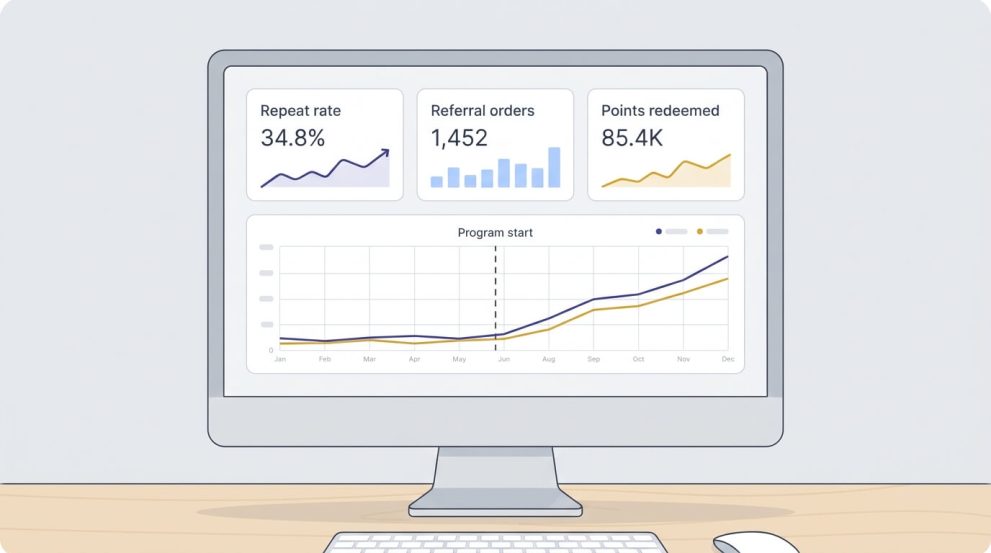
Track a small set of figures before and after launch:
Metric | What it tells you |
|---|---|
Repeat purchase rate | Whether a loyalty points program is changing buying habits |
Time between orders | Whether customers return sooner |
Share of new customers from referrals | Whether the referral program brings in buyers |
Cost per new customer | Whether referrals cost less than ads |
Points redeemed vs points issued | How much of your reward budget is being used |
Discount cost per order | Whether rewards fit your margin |
Give each program enough time to run before judging it. How long depends on how often your customers buy.
When You May Need Technical or Professional Help
Most stores can set up a basic points program without a developer. Outside help makes sense in these cases:
- You need to move existing points or customer balances from another system.
- Your checkout is heavily customised and the redemption form does not display correctly.
- You sell in several currencies and the point values need careful testing.
- You suspect fraud, such as repeated fake referrals.
- You need advice on tax treatment or consumer rules for rewards in your country. For this, speak to a qualified accountant or legal adviser.
For custom changes to Appsbd products, the product page points to a contact page for custom development.
Frequently Asked Questions
A referral program rewards customers for bringing in new buyers, so it supports customer acquisition. A loyalty points program rewards customers for their own actions, such as buying, so it supports customer retention. In the referral programs vs loyalty points comparison, the question is whether you need more customers or more repeat orders.
For loyalty points vs referral rewards for small stores, points are usually the easier starting point. They do not depend on a large customer base and they are simple to control. Add a referral program once you have customers who are happy to recommend you.
Yes. A common method is to pay referral rewards as points, so both programs share one balance. Set a limit on how many points can be redeemed per order so the two rewards do not reduce your margin too far.
No. They suit products people are willing to recommend, and that is more likely when the product is useful, visible, or easy to explain. Products that people prefer to keep private or buy very rarely tend to produce fewer referrals.
That depends on the plugin. Vite Rewards lists integration with Vitepos, a point of sale system for WooCommerce, so points can be managed in an in-store setup as well. Check the plugin documentation for the exact behaviour in your setup.
Compare repeat purchase rate and time between orders before and after launch. Also check points redeemed against points issued, and the discount cost per order.
Pay rewards only after a completed order, allow one reward per new customer, block self-referrals, and set a minimum order value. Review referral activity regularly for unusual patterns.
Conclusion
Referral programs vs loyalty points is not a question with one correct answer. Referral programs aim at customer acquisition and depend on satisfied customers who are willing to recommend you. Loyalty points aim at customer retention and depend on customers having a reason to buy again.
For most small WooCommerce stores, a loyalty points program is the simpler first step, because it works with the customers you already have and gives you control over the rules. Once your repeat orders are steady, a referral program can add new customers, and paying referral rewards in points ties the two together.
Check your repeat purchase rate and your cost per new customer first, set rewards you can afford, and test before launch. If you decide on points, Vite Rewards is one loyalty points plugin for WooCommerce stores to review alongside others, with the plan details above checked against your needs.
Subscribe
To get news about new releases, Updates, Blog Post, Deals and Discounts